





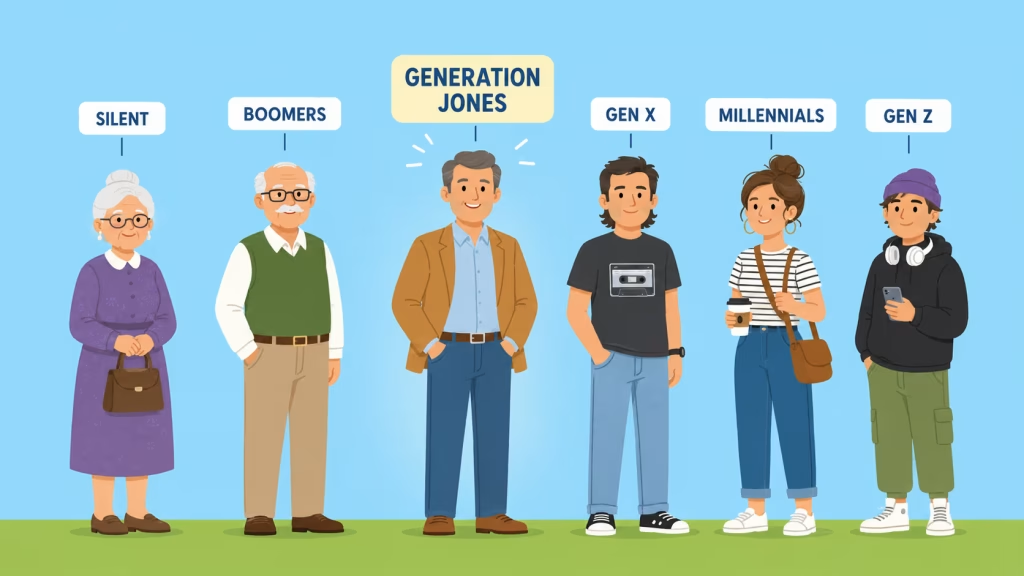
For decades, people born after World War II were broadly grouped into one category: Baby Boomers. But over time, sociologists and cultural historians noticed that many people born in the late 1950s and early 1960s had experiences that felt very different from older Boomers. That realization gave rise to the term “Generation Jones.”
What Is Generation Jones?
Generation Jones generally refers to people born between about 1954 and 1965. The phrase was coined by cultural commentator Jonathan Pontell in the 1990s to describe those who felt caught between the optimism of the Baby Boom generation and the skepticism of Generation X.
The word “Jones” comes from the expression “keeping up with the Joneses,” reflecting a generation that often felt they were striving for the prosperity and opportunities older Boomers seemed to enjoy more easily.
Although Generation Jones is technically part of the Baby Boom era, many members say they relate more closely to Gen X attitudes and culture.
How Generation Jones Differs From Baby Boomers
Older Baby Boomers were born shortly after World War II, between 1946 and the early 1950s. They grew up during a time of economic growth, suburban expansion, and cultural upheaval. Many experienced the idealism of the 1960s firsthand, including events such as Woodstock, the Civil Rights Movement, and anti-war protests.
Generation Jones, however, was younger during those transformative years. Many were children instead of teenagers or young adults during the height of the 1960s counterculture movement.
By the time Generation Jones entered adulthood in the late 1970s and early 1980s, the economy had changed dramatically. Inflation, rising unemployment, and corporate downsizing created a more uncertain future. Unlike older Boomers, many members of Generation Jones faced tougher competition for jobs and homeownership.
A Blend of Two Generations
Generation Jones is often described as a bridge between Boomers and Gen X. They remember life before the internet and smartphones, yet adapted quickly to technology in adulthood. They grew up with vinyl records and rotary phones but later embraced personal computers, cable television, and mobile devices.
Culturally, they were influenced by disco, early MTV, arcade games, and blockbuster movies of the late 1970s and 1980s. Many also experienced major historical events differently than older Boomers, including the Cold War, the energy crisis, and changing family structures.
Why the Term Matters Today
Today, the idea of Generation Jones continues to gain popularity because many people feel traditional generational labels oversimplify their experiences. Someone born in 1958 may not identify with the same life experiences as someone born in 1947, despite both being labeled Boomers.
Generation Jones highlights how even a few years can create dramatically different cultural and economic realities. It also reminds us that generations are not always clear-cut categories. Instead, they are shaped by the world people experience during their formative years.
In many ways, Generation Jones represents adaptability — a group that witnessed enormous social and technological change while carving out an identity somewhere between optimism and realism.