




Few games have stood the test of time quite like Mahjong. With its distinctive clicking tiles, strategic gameplay, and social atmosphere, Mahjong has captivated players for generations. Although many people believe it is thousands of years old, historians generally trace the game’s origins to China during the 19th century, where it evolved from earlier card and tile games.
Where Mahjong Began
Mahjong originated in China during the Qing Dynasty, likely in the regions around Shanghai and other eastern coastal provinces. While legends often claim that the philosopher Confucius invented the game, historians have found no evidence to support those stories. The earliest verifiable references to Mahjong date to the mid-to-late 1800s.
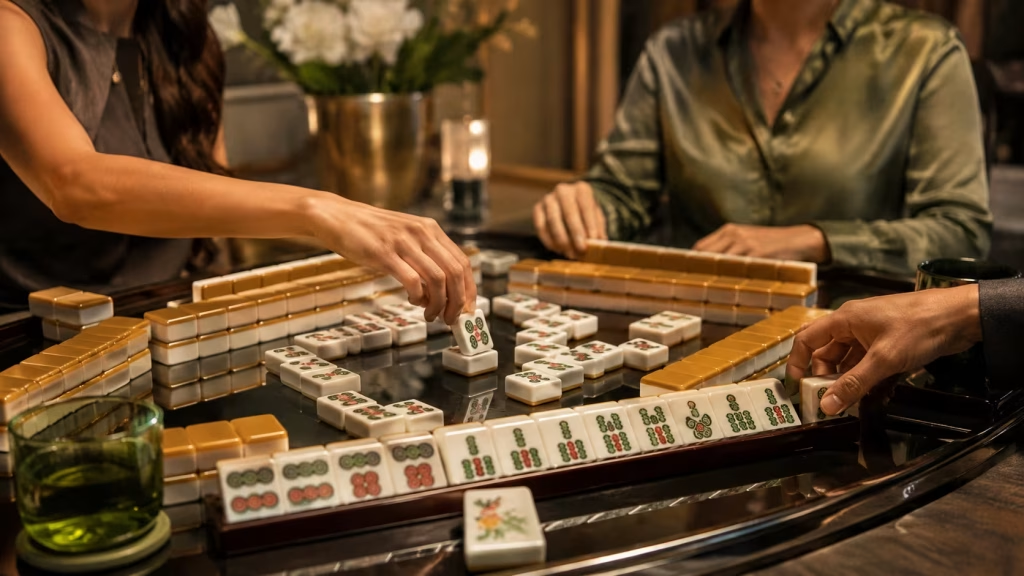
The name “Mahjong” is often translated as “sparrow,” possibly because the sound of shuffled tiles resembles the chattering of birds. The game uses a set of engraved tiles featuring suits, winds, dragons, and other symbolic designs. Players compete to build winning combinations while anticipating their opponents’ moves, creating a blend of skill, strategy, memory, and luck.
How Mahjong Spread Around the World
By the early 20th century, Mahjong had become enormously popular throughout China. Travelers and entrepreneurs introduced the game to Europe, Australia, and the United States during the 1920s. In America, Mahjong quickly became a social sensation, particularly among women’s clubs and community groups. The game was eventually standardized through organizations such as the National Mah Jongg League, which helped establish the American version still played today.
As Mahjong traveled, regional variations developed. Today, players can enjoy Chinese Classical Mahjong, Hong Kong Mahjong, Japanese Riichi Mahjong, American Mahjong, and several other styles, each with its own scoring systems and rules.
Why People Love the Game
Part of Mahjong’s enduring appeal is that it brings people together. Families, friends, and community groups often gather around a table for hours of conversation and competition. The game challenges memory, pattern recognition, and decision-making while remaining highly social. Researchers have even explored Mahjong from mathematical and artificial intelligence perspectives because of its strategic complexity.
Mahjong’s New Popularity
Today, Mahjong is experiencing a remarkable resurgence. Younger generations are discovering the game through social clubs, social media, mobile apps, and pop-culture references. In cities around the world, Mahjong nights have become trendy alternatives to screen-based entertainment. Many players are drawn to the game’s combination of strategy, community, and face-to-face interaction in an increasingly digital world.
Modern innovations such as automatic Mahjong tables and stylish designer tile sets have also helped attract new audiences. At the same time, many players appreciate the game’s deep cultural roots and its ability to connect generations.
A Timeless Tradition
More than a century after its creation, Mahjong continues to thrive. Whether played in a family living room, a community center, a bustling club, or on a smartphone, the game remains a fascinating blend of tradition, strategy, and social connection. Its ability to adapt to changing times while preserving its core appeal is precisely why Mahjong continues to win new fans around the globe.